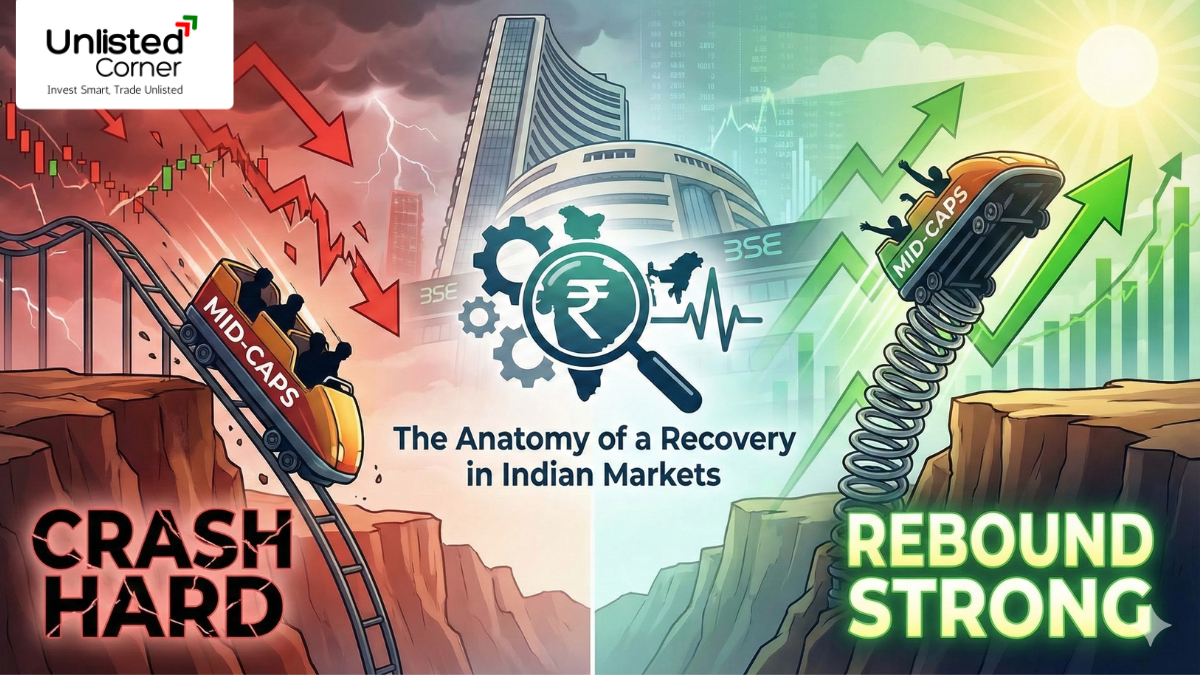
In the high-stakes world of the Indian stock market, mid-cap stocks are often described as the "adrenaline junkies" of an investor's portfolio. They offer a thrilling ride, capable of generating massive alpha during bull runs, yet prone to gut-wrenching declines when the tide turns.
As we navigate through 2025 and 2026, this volatility has been on full display. We've seen high-quality mid-caps plummet 30% or more, only to stage a spectacular recovery that leaves retail investors wondering: What just happened? Understanding the "Anatomy of a Recovery" is crucial. It’s the difference between panic-selling at the bottom and holding on for a multi-bagger return. This guide explores the mechanics of why mid-caps crash, the psychological traps they set, and the specific indicators that signal a powerful rebound is underway.
1. The Mid-Cap Paradox: High Beta and Thin Liquidity
The primary reason mid-caps (ranked 101-250 by market capitalization) crash harder than large-caps like Reliance or TCS is a combination of High Beta and Thin Liquidity.
- The Exit Door Problem: Large-caps have deep liquidity; thousands of buyers and sellers are active at any second. In mid-caps, when big institutional players (FIIs or DIIs) decide to sell, there aren't always enough buyers to absorb the volume. This creates a "bottleneck," forcing the price down rapidly.
- Beta Amplification: Mid-caps typically have a Beta greater than 1. This means if the Nifty 50 falls by 1%, a mid-cap might fall by 2% or 3%. During a broad market correction, this magnification makes the mid-cap segment look like it's in freefall.
2. Triggers of a "Hard Crash" in the Indian Context
Why does a steady mid-cap suddenly "break"? In 2025-26, we’ve identified four primary triggers:
- Valuation Excesses: When a mid-cap’s P/E ratio stretches 50-80% above its 10-year historical mean without a corresponding jump in earnings, it becomes a "ticking time bomb." A minor negative news event can trigger a massive de-rating.
- Regulatory & SEBI Alarms: We saw this in early 2025 when SEBI raised concerns about "overheating" in small and mid-cap mutual fund schemes. This led to institutional rebalancing, where fund managers were forced to sell mid-caps to maintain liquidity buffers.
- The Margin Call Cascade: Many HNIs (High Net-worth Individuals) trade mid-caps on margin. When prices drop, brokers trigger Margin Calls. If the investor can't provide cash, the broker sells the stock "at market," further driving down the price in a vicious cycle.
- Sectoral Tailwinds Turning into Headwinds: Mid-caps are often "pure plays" on specific sectors (like Solar, Specialty Chemicals, or Defense). If government policy shifts or global commodity prices spike, the entire sector crashes, taking its best mid-caps with it.
3. The Psychology of the Rebound: From Fear to FOMO
A strong rebound is rarely about a sudden change in business fundamentals; it’s about a shift in sentiment.
- The Capitulation Phase: This is the "hard crash" where even long-term holders give up. The "weak hands" exit, and the stock reaches a state of being "oversold."
- Institutional "Nibbling": Smart money (DIIs) looks for the "Value Gap." They realize that while the price fell 40%, the company's factory is still running and its order book is still full. They begin to buy quietly.
- The Short-Covering Spark: Traders who bet against the stock (short-sellers) eventually have to buy back to book their profits. This sudden buying pressure creates the initial "bounce."
- The Momentum Return: As the stock rises 10-15% from its lows, retail investors feel the FOMO (Fear Of Missing Out) and rush back in, fueling the strong rebound.
4. Checklist: How to Identify a "Strong Rebound" Candidate
Not every mid-cap that crashes will recover. Some stay down forever. To find the "Rebound Kings" of 2026, use this forensic checklist:
- ✅ Low Debt-to-Equity: Companies with high debt often go bankrupt during a crash. Those with cash on hand are the ones that survive to see the recovery.
- ✅ Stable Promoter Holding: Did the promoters sell during the crash? If they held steady or, better yet, increased their stake, it's a massive green flag.
- ✅ Improving Cash Flows: Ignore "Accounting Profit." Look at Cash Flow from Operations (CFO). If CFO is growing while the stock price is falling, a rebound is imminent.
- ✅ Sector Resilience: Is the industry still relevant? For example, while EV-related mid-caps crashed in 2025, the structural demand for EVs ensures a strong rebound in 2026.
📊 2025 Case Study: Mid-Cap Mayhem & Recovery
|
Stock Example (2025) |
Peak-to-Trough Fall |
Recovery Status (Q4 2025) |
Key Recovery Driver |
|
Kalyan Jewellers |
-36% |
Strong Rebound (+25%) |
Strong Festive Demand & Governance Clarity |
|
Dixon Technologies |
-31% |
Consolidating |
PLI Scheme Benefits & New Export Orders |
|
Oracle Fin. Serv. |
-37% |
Fast Recovery |
High Dividend Yield & IT Sector Revival |
|
Supreme Industries |
-30% |
Resilient |
Infrastructure Spending Boost |
🛡️ Strategic Conclusion: Don't Fear the Dip, Prepare for the Rip
A mid-cap crash is often a "Sentiment Storm" rather than a "Structural Failure." In the Indian market of 2026, the key to building wealth is distinguishing between a company whose price is broken and a company whose business is broken.
Ready to navigate the 2026 Mid-Cap Cycle?
❓ Frequently Asked Questions (FAQ)
Q1: Why do mid-caps fall more than the Nifty 50?
A: Mid-caps have higher Beta and lower liquidity. When institutions sell, the lack of immediate buyers causes the price to drop more sharply than it would for a large-cap stock.
Q2: How do I know if a mid-cap crash is a "Buying Opportunity" or a "Value Trap"?
A: Check the CFO (Cash Flow from Operations). If the company is still generating healthy cash despite the falling price, it’s likely an opportunity. If debt is rising and cash is falling, it’s a trap.
Q3: What role do FIIs play in mid-cap recoveries?
A: FIIs (Foreign Institutional Investors) are often the "Exit Trigger" for the crash but also the "Momentum Fuel" for the recovery. When they turn net buyers after months of selling, mid-caps usually lead the rally.
Q4: Should I use "Stop-Loss" for mid-cap stocks?
A: Yes. Because mid-caps can fall 20% in a single week, having a hard stop-loss (e.g., 15-20%) protects you from catastrophic losses in case the company has hidden fundamental issues.
Q5: Is it better to invest in Mid-Cap Mutual Funds or individual stocks?
A: For most retail investors, Mid-Cap Mutual Funds are safer because they provide professional diversification. Individual stocks are better only if you have the time to conduct deep fundamental research.
Q6: What is a "V-shaped" recovery?
A: It’s a recovery where the stock bounces back as quickly as it fell. This usually happens in mid-caps when a crash was caused by "Market Panic" rather than a real economic problem.
Q7: Can a mid-cap stock become a large-cap during a rebound?
A: Yes. This is called "Re-rating." If a company improves its earnings significantly during a recovery, it can move up the SEBI market-cap categories, attracting even more institutional money.
Q8: How does the India VIX affect mid-caps?
A: A rising India VIX (Volatility Index) signals fear. Mid-caps usually crash when the VIX is above 18-20 and tend to rebound strongly when the VIX starts cooling down.
Disclaimer
Investing in mid-cap stocks involves a high degree of risk, including the loss of principal. The analysis provided is based on 2025-26 market trends and should be used for educational purposes only. Always consult a SEBI-registered financial advisor before making any investment decisions.