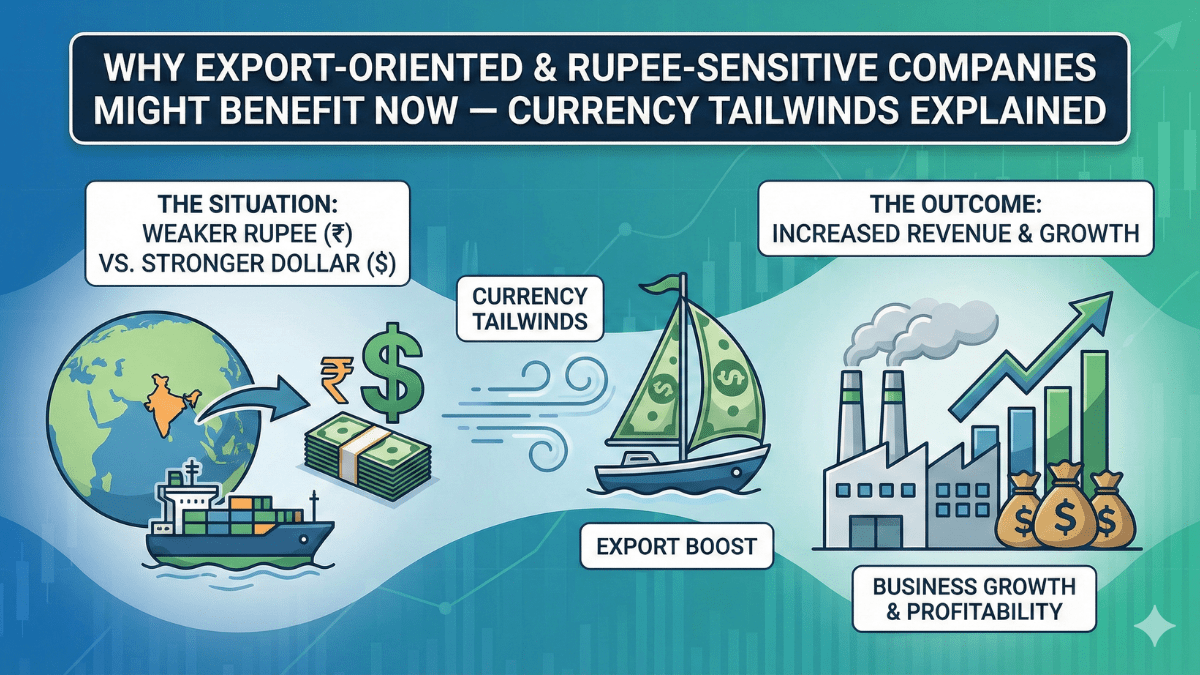
The Indian equity market in early 2026 is witnessing a fascinating paradox. While persistent foreign fund outflows and global trade uncertainties have put the Indian Rupee under significant stress—slipping past the 91 per US dollar mark in late 2025 and hovering near 90 in January 2026—a specific segment of the market is quietly celebrating.
For export-oriented companies, a weakening rupee isn't a sign of economic distress; it’s a powerful "currency tailwind" that acts as a secret engine for profit margins. We explore why rupee-sensitive sectors like IT, Pharma, and Chemicals are positioned to be the "dark horses" of 2026.
🏗️ 1. The Mechanics of Currency Tailwinds: How It Works
To understand why a weak rupee helps an exporter, we have to look at the "conversion math."
- The Revenue Boost: Most Indian exporters bill their international clients in US Dollars (USD). If a software firm in Bengaluru sells a service for $1,000, and the rupee is at 85, they earn ₹85,000. If the rupee slides to 91, that exact same $1,000 service suddenly brings in ₹91,000.
- Fixed Domestic Costs: While their revenue is tied to the dollar, most of their costs (salaries in India, office rent, electricity) are in rupees. This gap between rising "dollar-denominated revenue" and stable "rupee-denominated costs" leads to immediate margin expansion.
- Price Competitiveness: A weaker rupee allows Indian exporters to lower their dollar prices slightly to win global contracts without losing any profit in rupee terms. This makes Indian goods more attractive compared to competitors from countries with stronger currencies.
🚀 2. The "Big Three" Sectors Set to Benefit in 2026
A. Information Technology (IT) – The Traditional Leader
The IT sector is often the first to react to rupee volatility. Major players like TCS, Infosys, and HCLTech derive over 80% of their revenue from overseas markets (primarily the US and Europe).
- The AI Reset: In 2026, IT companies are investing heavily in Agentic AI. The extra margins from the depreciating rupee provide the much-needed "innovation capital" to retrain staff and acquire AI startups without hurting the bottom line.
- Natural Hedge: For foreign investors, Indian IT stocks act as a "natural currency hedge." If the rupee weakens, the company’s earnings tend to rise, offsetting the currency loss for the investor.
B. Pharmaceuticals – The Global Pharmacy
India is the "obesity capital" and "pharmacy of the world." With the global boom in GLP-1 (weight-loss) drugs and generic medicine, Indian pharma giants are seeing massive dollar inflows.
- Low Import Intensity: Unlike electronics, many pharma companies source raw materials locally, meaning the higher cost of imports doesn't negate their export gains.
- USD Realization: Companies like Sun Pharma and Dr. Reddy's report that every ₹1 depreciation against the dollar can boost EBITDA by hundreds of crores on an annualized basis.
C. Specialty Chemicals & Agro-Based Products
As global supply chains shift away from a "China-only" model, Indian chemical manufacturers are seeing a structural surge in demand.
- Agro-Based Edge: Food and agro-exports (Basmati rice, spices) have very low import dependence. This makes them the "purest" beneficiaries of rupee depreciation, as almost every extra rupee earned is pure profit.
📉 3. The 2026 Rupee Outlook: Why the Slide Continues
The Indian Rupee entered 2026 on a weak note, settling around 89.98 on the first trading day. Several factors are keeping the currency under pressure:
- FII Outflows: Foreign Institutional Investors sold equities worth over ₹3,500 crore in a single session in early January. As they pull out money, they sell rupees and buy dollars, driving the rupee's value down.
- Tariff Uncertainties: With reciprocal tariffs announced by the US in 2025, trade-related uncertainty is high. Market participants are cautious, keeping the dollar index firm around the 98.32 mark.
- Interest Rate Differentials: While the RBI implemented rate cuts in 2025 to support domestic growth, these cuts have reduced the "carry trade" attractiveness of the rupee compared to the US dollar.
⚖️ 4. The "Import Intensity" Trap: Not All Exporters Win
While a weak rupee is generally good for exports, it’s a double-edged sword for industries that rely on imported raw materials.
- Electronics & Petroleum: These sectors have high "Import Intensity." If a company imports 60% of its components in dollars, the higher cost of those imports often eats up the gains made from selling the final product in dollars.
- Gems & Jewellery: Since India imports almost all its raw gold and rough diamonds, rupee depreciation often widens the trade deficit for this sector rather than improving it.
🛡️ 5. Strategy for Investors: How to Play the Currency Tailwind
If you believe the rupee will test the 92–93 levels in mid-2026, your portfolio should reflect "Currency Resilience."
- Focus on Large-Cap Exporters: Large-cap IT and Pharma firms have sophisticated hedging strategies that protect them from sudden, extreme volatility while allowing them to capture long-term depreciation gains.
- Watch the REER: The Real Effective Exchange Rate (REER) measures the rupee against a basket of currencies. In 2026, a "fairly valued" REER is essential for maintaining India's export competitiveness against peers like Vietnam and Mexico.
- Diversify Internationally: Use the rupee's weakness as a signal to diversify. Investing in global funds or US stocks via GIFT City allows you to hold assets in a stronger currency (USD), providing a hedge against domestic rupee depreciation.
❓ Frequently Asked Questions (FAQ)
Q1: Is a weak rupee bad for the Indian economy? A: It’s a mix. It’s bad for consumers (higher fuel and electronics prices) but excellent for export competitiveness and local manufacturers who compete with expensive imports.
Q2: Which sectors are the biggest winners of rupee depreciation? A: Traditionally, IT Services, Pharmaceuticals, Automobiles (with high export traction), and Agro-based products are the top beneficiaries.
Q3: Does the RBI intervene to stop the rupee from falling? A: The RBI doesn't target a specific level but intervenes (by selling dollars from its reserves) to curb extreme volatility and ensure the slide is gradual rather than a crash.
Q4: What is "Hedging" in exports? A: Hedging is a financial strategy (using forwards or options) to lock in an exchange rate for a future date, protecting the exporter from sudden rupee appreciation.
Q5: How does a weak rupee affect my mutual fund investments? A: If you hold "Export-oriented" or "International" funds, your returns might improve. However, if you hold "Import-heavy" sectors like Oil & Gas or Paints, the returns might be muted.
Q6: What is the "REER" and why does it matter? A: The Real Effective Exchange Rate compares the rupee to a basket of other currencies. If the REER is too high, Indian exports become expensive even if the rupee is weak against the dollar.
Q7: Will US tariffs negate the benefit of a weak rupee in 2026? A: Possibly. If the US imposes a 10% tariff on Indian goods, a 5% rupee depreciation only covers half of that cost. Domestic execution and cost-cutting become vital.
Q8: Why is the rupee called a "Carry Trade" currency? A: Investors borrow in low-interest currencies (like the Yen) to invest in high-interest currencies (like the Rupee). When the RBI cuts rates, this trade becomes less profitable, leading to rupee weakness.
Disclaimer Currency markets are highly volatile and influenced by global geopolitics, central bank policies, and trade agreements. The analysis provided is based on early 2026 market trends and should be used for educational purposes only. Always consult a SEBI-registered financial advisor or a certified forex consultant before making investment or hedging decisions.