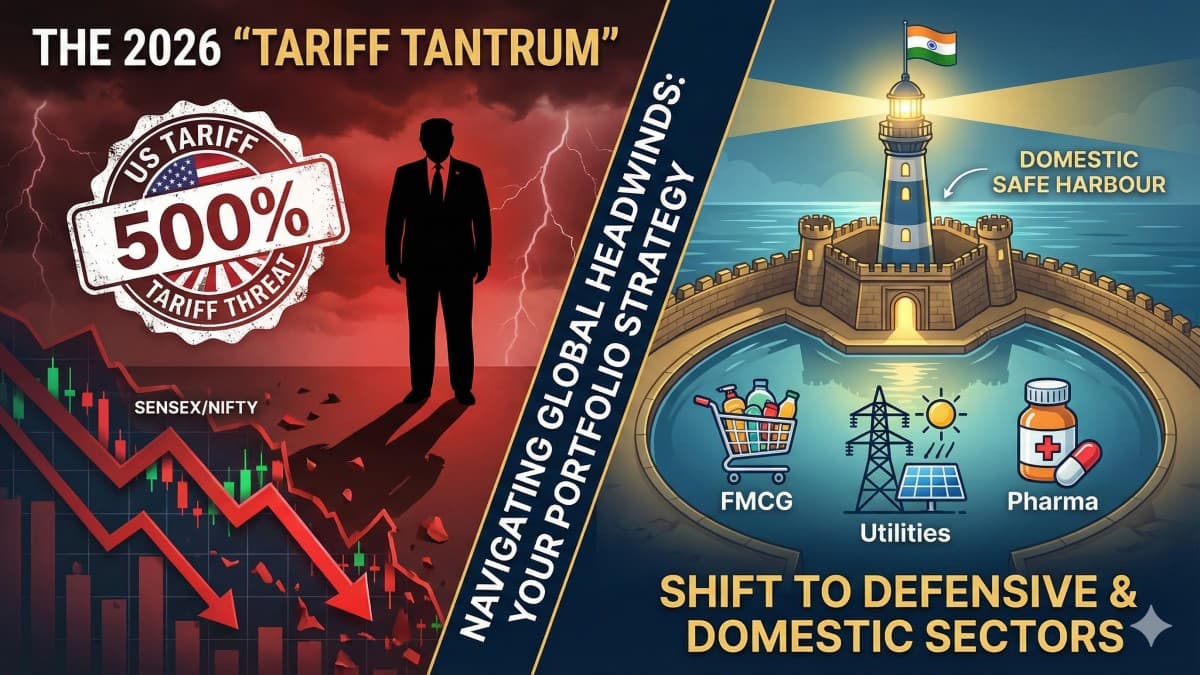
If you were watching the terminals this past Friday, January 9th, the sea of red across the NSE and BSE was impossible to ignore. The Indian stock market, having enjoyed a relatively buoyant start to the year on hopes of interest rate easing, faced a violent reality check. The Sensex shed over 600 points, and the Nifty 50 tumbled nearly 200 points, erasing weeks of gains in a single session.
While market corrections are a healthy part of any financial cycle, the catalyst for this specific sell-off is what demands immediate and serious attention from every thoughtful investor.
The shockwaves didn't emanate from corporate earnings or RBI policy. They came from Washington, D.C. The sudden, aggressive threat by US President Trump to impose a staggering 500% tariff on nations that continue to purchase Russian oil—a list on which India features prominently—has re-injected massive geopolitical risk into global equities.
In an instant, the narrative shifted from "growth and easing" to "trade wars and protectionism." This is not merely a rhetorical threat; it is a potential wrecking ball for global supply chains. In this volatile climate, where the "America First" policy threatens to upend established trade routes, chasing high-beta growth stocks exposed to global winds is perilous.
The smartest strategic move right now is looking inward. It is time to analyze why shifting portfolio weight towards domestic-oriented, defensive sectors is not just a safety play, but perhaps the only prudent strategy for the first quarter of 2026.
The Anatomy of the Panic: Why the Market Cracked
To understand where to hide, we must first understand what we are hiding from. The market reaction on Friday was not panic without reason; it was a rational pricing-in of a new, severe risk.
1. The Geopolitical Squeeze on Oil
India's economic resilience in recent years has partly stemmed from its ability to source cheaper crude oil from Russia, keeping domestic inflation manageable despite global energy shocks. The US threat strikes directly at this economic advantage.
If India is forced to buckle under tariff pressure and stop buying Russian oil, it must source crude from elsewhere at significantly higher global market prices. This leads to immediate "import-push inflation," drastically increasing India's import bill, widening the Current Account Deficit (CAD), and tying the RBI's hands regarding future rate cuts. The market hates inflation, and it hates uncertainty even more.
2. The FII Exodus and the Currency Feedback Loop
Foreign Institutional Investors (FIIs) are notoriously fickle when geopolitical risks rise. They prefer the relative safety of the Dollar over the volatility of Emerging Markets (EMs) during trade spats.
We are already witnessing persistent FII selling in January 2026. This selling pressure creates a negative feedback loop: as FIIs sell rupees to repatriate dollars, the INR weakens. A weakening Rupee further eats into the dollar returns of remaining foreign investors, encouraging more selling. While a weak rupee helps some exporters (as we have discussed previously), a rapidly depreciating rupee due to capital flight destabilizes the entire macro environment.
3. The Death Knell for High-Export Beta
A 500% tariff is not a trade barrier; it is a trade prohibition. Any Indian sector with significant revenue exposure to the US market is now facing an existential crisis until clarity emerges. The market immediately de-rated these stocks on Friday, anticipating a complete collapse in their US order books if the threats materialize.
The Crosshairs: Sectors Most Vulnerable to Tariff Shocks
Before identifying the safe harbours, investors must audit their portfolios for exposure to the storm centers. The following sectors are currently the highest risk:
-
Auto Ancillaries & Components: Many Indian component makers have thrived by integrating into North American supply chains for giants like GM and Ford. A punitive tariff would make Indian components uncompetitive overnight versus suppliers from Mexico or Vietnam.
-
Textiles and Apparel: The US is a massive market for Indian textiles. This sector operates on thin margins and fierce competition from Bangladesh and Vietnam. It cannot absorb significant tariffs, let alone triple-digit ones.
-
Certain Metals and Specialty Materials: Steel and aluminum exports to the US have historically been targets of protectionist administrations. They are likely front-line casualties in any new trade war.
-
Dollar-Debt Heavy Corporations: This is a secondary effect. Companies that borrowed heavily in USD during the low-interest rate era are now facing a double whammy: high US interest rates for refinancing, and a weakening Rupee, making loan servicing much more expensive in local currency terms.
The Strategic Pivot: The Case for the "Domestic Defensive"
When global trade routes are threatened by political hurricanes, the safest strategy is to invest in companies whose fortunes are tied to the Indian consumer living in Mumbai or Meerut, rather than the policymaker sitting in Washington.
The thesis is simple: India's domestic consumption story and its internal infrastructure build-out are largely insulated from US tariffs. These sectors may not offer the explosive growth of a tech startup during a boom, but they offer resilience, cash flow visibility, and stability during a bust.
Here are the three key pillars of a 2026 defensive portfolio:
Pillar 1: Fast-Moving Consumer Goods (FMCG) – The Ultimate Necessity
FMCG is the classic recession-proof sector. Regardless of whether President Trump imposes tariffs or not, 1.4 billion Indians will still need toothpaste, soap, biscuits, and cooking oil every morning.
-
The Pricing Power Advantage: In an inflationary environment (which could occur if oil prices spike), established FMCG giants have "pricing power." They can pass on increased raw material costs to consumers because demand for their products is inelastic. People cut back on buying new cars before they cut back on buying milk.
-
What to look for: Focus on market leaders with pristine balance sheets and deep rural distribution networks like Hindustan Unilever (HUL), ITC, or Nestle India. These stocks tend to act as counter-cyclical buffers when the high-beta Nifty names are bleeding.
Pillar 2: Domestic Infrastructure and Utilities – The Internal Engine
The Government of India's massive capital expenditure (capex) push on roads, railways, ports, and green energy is distinct from global trade dynamics. The demand for power in India is structural and growing internally.
-
The Opportunity in the Dip: Friday's sell-off dragged down solid performers indiscriminately. For instance, power utility giant NTPC fell over 2.4% and Adani Ports dropped over 2.1%.
-
Why are they defensive? These are regulated businesses with predictable cash flows. A power plant's profitability depends on the CERC (Central Electricity Regulatory Commission) guidelines and domestic power demand, not on US trade policy. Buying these structurally sound, domestically focused assets on dips caused by global panic is often a winning long-term strategy.
Pillar 3: The Nuanced Play – Pharmaceuticals
Pharma is often categorized as an export sector, which might seem contradictory to this thesis. However, Indian Pharma is unique.
-
Essential vs. Discretionary: Unlike textiles or auto parts, Indian generic drugs are essential to the US healthcare system. They help keep US healthcare costs down. While they could technically be targeted by tariffs, it is politically very difficult for any US administration to raise drug prices for its own citizens by taxing Indian generics.
-
The Currency Tailwind: Furthermore, Pharma is one of the few sectors that genuinely benefits from the weakening Rupee (which may hit 92-93 per USD soon) without facing the same level of demand destruction risk as other exporters. Companies like Sun Pharma or Dr. Reddy's offer a defensive hedge within the export basket.
The Week Ahead: Navigating Earnings Amidst Geopolitical Noise
Investors face a critical test in the coming week, starting Monday, January 12th, 2026. We have a collision of micro and macro events.
We kick off the Q3 earnings season with IT behemoths TCS and HCL Tech. Typically, IT stocks benefit from a weak rupee. However, the current geopolitical overhang is so massive that even good results might get overshadowed by the fear of broader US economic retaliation that could hurt IT spending.
Simultaneously, we await domestic inflation data, expected to inch up to around 1.5%. If inflation surprises on the upside while the tariff threat looms, the RBI will be firmly on hold, further dampening market sentiment.
The Verdict: The "tariff tantrum" has fundamentally altered the near-term risk-reward ratio. The strategy now must shift from aggressive wealth creation to intelligent capital preservation. By rotating exposure out of tariff-sensitive exporters and into the resilience of the domestic Indian economy, investors can construct a portfolio built to weather the geopolitical storm. In early 2026, boring is beautiful.
Frequently Asked Questions (FAQ)
Q1: Should I sell all my IT stocks like TCS and Infosys because of the US tariff threats?
A: Not necessarily panic selling, but caution is warranted. While IT companies aren't exporting physical "goods" subject to these specific tariffs, they are heavily dependent on US corporate spending. If trade wars lead to a US economic slowdown, IT budgets could be cut. However, they also benefit from a weaker Rupee. It's best to wait for management commentary during this week's earnings calls regarding the demand outlook before making drastic changes.
Q2: If the Rupee weakens, doesn't that hurt the whole economy?
A: It's a double-edged sword. A gradual weakening helps exporters (like IT and Pharma) make more money in rupee terms. However, a rapid, volatile fall driven by panic selling increases the cost of imports (like oil and electronics), fueling inflation and making it harder for Indian companies with dollar debt to repay their loans. The current rate of depreciation is concerning because it's driven by capital flight.
Q3: Why are FMCG stocks considered "defensive"? Don't they also import raw materials?
A: They do import some materials (like palm oil or crude derivatives for packaging), so they aren't totally immune to global prices. However, they are "defensive" because demand for their products is stable regardless of the economic climate. They also have strong pricing power, meaning they can raise prices to consumers to protect their profit margins if their input costs rise.
Q4: The article mentions buying Utilities on dips. Isn't that risky in a falling market?
A: Buying the dip requires patience and conviction. The argument is that utility companies like NTPC or Power Grid have regulated business models whose revenue is tied to domestic Indian power consumption, which is growing. If their stock price falls purely because of global panic, it presents an opportunity to buy a stable future cash flow at a discounted present price.
Q5: How long will this "Tariff Tantrum" last?
A: This is entirely dependent on geopolitical negotiations. These threats are often used as leverage in diplomatic talks. The situation could de-escalate quickly if a deal regarding oil purchases is reached, or it could drag on, causing prolonged volatility. Investors should structure their portfolios assuming the uncertainty will persist for at least the current quarter.
Disclaimer Currency markets are highly volatile and influenced by global geopolitics, central bank policies, and trade agreements. The analysis provided is based on early 2026 market trends and should be used for educational purposes only. Always consult a SEBI-registered financial advisor or a certified forex consultant before making investment or hedging decisions.