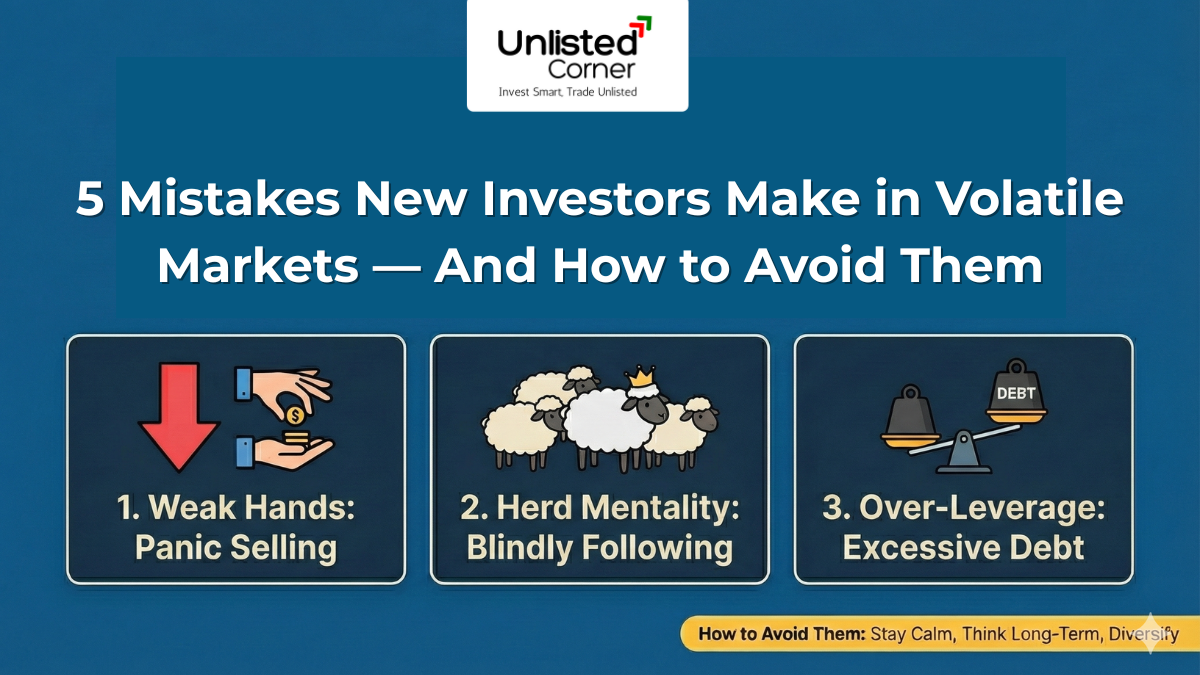
Market volatility can feel like a rollercoaster ride where the tracks are invisible and the seatbelts feel loose. For new investors, seeing a portfolio dip into the "red" often triggers a primal "fight or flight" response. This emotional turbulence leads to predictable, yet costly, mistakes that can derail long-term financial goals.
Understanding the psychology of the market is just as important as understanding the math. Terms like "Weak Hands," "Herd Mentality," and "Over-Leverage" aren't just jargon—they describe the specific behavioral traps that separate those who build wealth from those who lose it.
This guide explores the five most common mistakes new investors make in volatile markets and provides a tactical roadmap to help you navigate the storms with a steady hand.
1. The "Weak Hands" Trap: Panic Selling During Dips
In trading parlance, "Weak Hands" refers to investors who lack the conviction or financial buffer to hold through market turbulence. When prices drop, these investors are the first to sell, often at the very bottom, effectively turning a "notional loss" (a loss on paper) into a "realized loss" (actual money gone).
- The Mistake: Reacting to short-term price drops by selling assets to "stop the bleeding." This often happens because the investor has no long-term plan or has invested money they actually need in the short term.
- The Psychological Trigger: Loss Aversion. Behavioral finance shows that the pain of losing $1,000 is twice as intense as the joy of gaining $1,000. This asymmetry drives investors to make irrational exits just to end the emotional pain.
How to Avoid It:
- Build an Emergency Fund: Never invest money that you might need in the next 3–5 years. Having 6 months of living expenses in a liquid savings account gives you the "mental margin" to ignore market dips.
- Focus on Time in the Market, Not Timing: Historically, the best days in the stock market often follow the worst days. If you sell during a crash, you risk missing the recovery bounce, which is where the most significant gains are made.
2. Falling for "Herd Mentality": Following the Crowd into the Abyss
Herd mentality is the tendency for individuals to mimic the actions of a larger group. In a bull market, this leads to "FOMO" (Fear Of Missing Out) and buying overvalued assets. In a volatile or bear market, it leads to mass panic.
- The Mistake: Buying because everyone is talking about a "hot tip" or selling because the headlines are filled with doomsday predictions.
- The Risk: By the time the "herd" is moving, the price has usually already adjusted. Buying with the herd often means buying high, and selling with the herd means selling low.
How to Avoid It:
- Do Your Own Research (DYOR): Before buying any asset, you should be able to explain why you own it in two sentences. If your reason is "my friend bought it" or "I saw it on a YouTube thumbnail," you are part of the herd.
- Stick to Your Financial Plan: Your investment strategy should be based on your goals, your age, and your risk tolerance, not the collective anxiety of the internet.
3. The "Over-Leverage" Disaster: Playing with Fire
Leverage involves using borrowed money (margin) to increase the potential return on an investment. While leverage can amplify gains in a steady market, it is a "double-edged sword" that can wipe out an entire account in a volatile one.
- The Mistake: Using excessive margin or trading complex derivatives (like Futures and Options) without fully understanding the downside.
- The Risk: In a volatile market, prices can swing 5–10% in a single day. If you are 10x leveraged, a 10% drop against your position means a 100% loss of your capital. This often triggers a Margin Call, where the broker forcibly liquidates your positions at the worst possible price.
How to Avoid It:
- Avoid Margin as a Beginner: If you are new to the markets, stick to "cash-and-carry" investing—only buy what you can afford with your own money.
- Understand Position Sizing: Never risk more than 1–2% of your total portfolio on a single high-risk trade. Proper position sizing ensures that even a string of losses won't bankrupt you.
4. Stopping SIPs When the Market is "Red"
For many investors, Systematic Investment Plans (SIPs) or Dollar-Cost Averaging (DCA) are the best ways to build wealth. However, when the market turns volatile, many beginners stop their SIPs to "wait for things to settle down."
- The Mistake: Pausing regular investments during a market downturn.
- The Missed Opportunity: Volatile markets are actually the best time for SIPs. When prices are low, your fixed monthly investment buys more units or shares. This reduces your average cost of acquisition, leading to much higher returns when the market eventually recovers.
How to Avoid It:
- Automate Your Investments: Set your SIPs on autopilot so you don't have to make a "decision" every month.
- View Red Markets as a "Sale": Shift your mindset. A market dip is a "seasonal discount" on quality companies. You wouldn't stop shopping at your favorite store just because they announced a 30% discount; the same logic applies to stocks.
5. Ignoring Diversification: Putting All Your Eggs in One Basket
New investors often get hyper-focused on one sector (like Tech or Crypto) because it has performed well recently. When volatility hits that specific sector, they have no "buffer" to protect their capital.
- The Mistake: A concentrated portfolio that lacks exposure to different asset classes (Debt, Gold, International Equities) or market caps (Large, Mid, Small).
- The Result: Extreme volatility. A diversified portfolio might fall 5% in a week, while a concentrated one might fall 20%.
How to Avoid It:
- The 5–10% Rule: Avoid putting more than 5–10% of your total wealth into any single stock or high-risk asset.
- Asset Allocation: Ensure your portfolio has a mix of assets that don't move in perfectly correlated ways. For example, when stocks fall, gold or high-quality bonds often hold their value or even rise.
🛡️ Strategic Conclusion: Invest with a Partner, Not a Predictor
Market volatility is not a bug; it is a feature of the financial system. The goal isn't to avoid volatility, but to survive it. Successful investing is 20% head-knowledge and 80% behavior. By avoiding the traps of "Weak Hands" and "Herd Mentality," you place yourself in the top 10% of investors who actually achieve their long-term goals.
Ready to build a resilient, evidence-based portfolio that stands the test of time?
❓ Frequently Asked Questions (FAQ)
Q1: What is the single best way to manage volatility? A: Diversification. Spreading your money across different asset classes (Equities, Debt, Gold) ensures that a crash in one doesn't destroy your entire net worth.
Q2: How do I know if I have "Weak Hands"? A: If you find yourself checking your portfolio 10 times a day and feeling physical anxiety when the market is down 2%, you might have weak hands. This usually means you are over-leveraged or lack a clear long-term plan.
Q3: Is it ever okay to sell during a volatile market? A: Yes, but only for fundamental reasons, not emotional ones. If the reason you bought a company has changed (e.g., bad management, falling profits), then selling is a rational choice. Selling just because the price is down is usually a mistake.
Q4: What is "Margin Call"? A: A margin call happens when your account value falls below a certain level required by your broker to maintain your borrowed positions. The broker will then sell your stocks automatically to recover their money.
Q5: Should I try to "Time the Bottom"? A: No. Even professional fund managers rarely catch the exact bottom. It is much safer to use Dollar-Cost Averaging (SIP) to buy gradually as the market falls.
Q6: What are "Safe Haven" assets? A: Historically, Gold and Government Bonds are considered safe havens. During extreme market fear, investors flee "risk-on" assets (like stocks) and buy these to protect their capital.
Q7: How often should I rebalance my portfolio during volatility? A: Generally, once every 6–12 months is enough. Constant rebalancing can lead to high transaction costs and taxes. Only rebalance if your asset allocation has drifted significantly (e.g., your 70% stock allocation has become 85% because of a rally).
Q8: Does volatility mean the economy is in trouble? A: Not necessarily. The stock market is a "leading indicator" and often moves based on expectations rather than current reality. Volatility can be caused by interest rate changes, global events, or simply a "cool-off" after a long period of growth.
Disclaimer The information provided in this blog is for educational purposes only and does not constitute financial, legal, or investment advice. Investing in the stock market involves significant risk of loss. Past performance is not indicative of future results. Always consult with a certified financial advisor before making significant investment decisions.